More Protocols, More Choice
Choose from 16 protocol options, including our in-house Talaria and Everest protocols, alongside WireGuard, OpenVPN, and more.
We use cookies to provide you a better service and analyze traffic. To find out more about cookies, please see our Cookie Declaration. By continuing to browse our website, you agree to our use of cookies.
We use cookies to provide you a better service and analyze traffic, To find out more about cookies, please see our Cookie Declaration.
Our website relies on these cookies for proper functionality.
These cookies are utilized to retain your preferences, such as language selection.
Cookies enable us to gain insights into our visitors and enhance their browsing.
Cookies that are used to track conversions for ads platforms.
X-VPN has developed 16 VPN protocols to provide the best VPN service to users worldwide.
Get X-VPN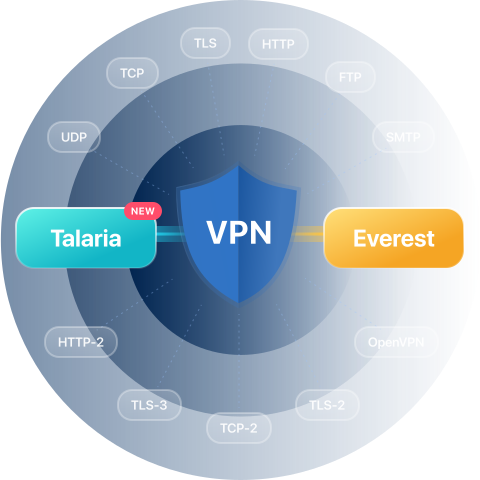

A VPN protocol is a set of rules that determines how your device establishes a secure connection to a VPN server and how data is transmitted through that connection.
Different VPN protocols are designed with different priorities, such as speed, security, compatibility, and connection stability. X-VPN supports multiple protocols to help you find a reliable connection for your device and network conditions.
X-VPN has developed multiple VPN protocols based on the global network environment, and is continually adding more protocols.
Different VPN protocols have different strengths. Compare Talaria, Everest, WireGuard, V2Ray, and OpenVPN across five key factors: speed, stability, security, network access, and compatibility. Select a protocol in the chart to explore its strengths and find the right fit for your needs.
Note: All protocols except TLS-3 are free to use and compatible with any server available to you. TLS-3 requires Premium and is only available when connecting through The Fastest Server or Everest Line.
Choose from 16 protocol options, including our in-house Talaria and Everest protocols, alongside WireGuard, OpenVPN, and more.
Talaria is designed for efficient data transfer, helping you make better use of available bandwidth for streaming, downloads, and everyday browsing.
Our in-house Talaria protocol is open source and has undergone an independent security assessment, offering greater transparency into the technology behind your connection.
X-VPN's Everest protocol offers multiple connection modes to help maintain reliable connections across different network conditions, including restrictive networks.
We recommend starting with Auto, which lets X-VPN select a suitable protocol based on your network conditions. You can also choose manually: try Talaria or WireGuard for speed, OpenVPN for broad compatibility, or Everest for challenging network environments.
Talaria is X-VPN's in-house VPN protocol, built for speed and efficient data transfer. It's designed to make better use of available bandwidth, especially for streaming and large downloads. Talaria also uses TLS 1.3 and hybrid post-quantum key exchange to help protect your connection.
Everest is X-VPN's proprietary VPN protocol, designed to provide reliable connections across different network conditions. It uses AES-256 encryption and offers multiple connection modes, including UDP, TCP, TLS, and HTTP. Its obfuscation technology also helps maintain connectivity on restrictive networks.
Talaria and WireGuard are both strong options for speed. Talaria is optimized for efficient data transfer, particularly on high-bandwidth networks, while WireGuard is known for its lightweight design and performance. Actual speeds depend on your device, server, and network conditions, so it's worth trying both.
Yes. Talaria is X-VPN's in-house VPN protocol, with its source code available on GitHub under the AGPLv3 license. It has also undergone an independent security assessment by Vantage Point Security, which identified no security vulnerabilities within the scope of the review.
X-VPN's VPN protocols use different security technologies to protect your connection. Everest uses AES-256 encryption, WireGuard uses ChaCha20-Poly1305, and Talaria uses TLS 1.3 with hybrid post-quantum key exchange. Each protocol has its own security design rather than relying on the same encryption method.
No. Protocol availability varies by device, app version, and installation method. Talaria is available on supported Windows, macOS, iOS, and Android versions, while some TV, router, and browser versions offer fewer protocol options. Check the Supported Devices table above for details.
X-VPN may switch protocols when your selected protocol cannot establish a connection or when network conditions change. This helps the app find another available way to connect. Some dedicated server lines also require a specific protocol, such as TLS-3 for Everest Line.

Follow us on social media, don't miss updates, tips and the latest news.


We believe X-VPN provides you with the best VPN service. Anyway, get a refund if you are not satisfied, no risk.
Try X-VPN Risk-Free Try X-VPN Risk-Free