
Can My ISP See I’m Using a VPN?
While a VPN encrypts your traffic, your internet provider can still detect that a VPN connection is being used. Here’s a deeper explanation of what your ISP can and can’t see when you use a VPN.


As we move toward 2026, online privacy is no longer optional—it’s a daily concern for anyone who uses the internet. Data brokers, advertisers, ISPs, and governments collect more information than ever, often invisibly. Your IP address alone can reveal your location, habits, and identity.
Two tools dominate the privacy conversation: Tor and VPNs. Both are designed to protect your online activity—but they solve very different problems.
Confusing them doesn’t just lead to slower browsing or blocked streaming apps. In certain situations, choosing the wrong tool can undermine your privacy or expose you to unnecessary risk.
This guide breaks down how Tor and VPNs actually work, where each one excels, their real-world limitations, and how to choose the right tool based on your threat model, not hype.

Quick Takeaways
• VPNs are faster, easier, and better for streaming and everyday privacy
• Tor offers stronger anonymity but is significantly slower
• VPNs require trusting a single provider; Tor distributes trust across multiple nodes
• Neither makes you completely anonymous—both have limitations
• For most users, a trustworthy no-logs VPN offers the best balance of privacy and usability. X-VPN completed no-logs policy verification by one of the Big Four accounting firms in 2026.
A Virtual Private Network (VPN) creates an encrypted tunnel between your device and a remote server operated by the VPN provider.

1. Your data is encrypted – All internet traffic from your device is scrambled into unreadable code
2. Traffic routes through VPN server – Your encrypted data travels through your ISP to the VPN server
3. VPN server accesses websites – The VPN server decrypts your request and connects to the destination on your behalf
4. Response returns encrypted – The website’s response is encrypted and sent back through the VPN tunnel to you
From the perspective of the websites you visit, your connection appears to originate from the VPN server’s location—not your actual location. This masks your real IP address and can make it seem like you’re browsing from a different country.
In plain English: A VPN hides your IP address and protects your connection, especially from ISPs, hackers on public Wi-Fi, and basic tracking.


X-VPN offers a Premium plan for $2.99 per month with a 24-month subscription, along with a no-account-required free version. Both plans follow a no-logs policy verified by one of the Big Four auditing firms and are designed to deliver fast connection speeds.
Tor (The Onion Router) is a free, decentralized anonymity network designed to make tracking users extremely difficult.
Unlike a VPN’s single encrypted tunnel, Tor bounces your internet traffic through multiple volunteer-operated servers (called “nodes” or “relays”) before reaching its destination.
(1) Entry (Guard) Node – Knows your IP address, but not your destination
(2) Middle Relay – Knows neither your identity nor your destination
(3) Exit Node – Knows the destination, but not who you are
Each layer of encryption is removed one step at a time—like peeling an onion. No single node can see the full picture. This design is explained in detail in the Tor Project’s official documentation, which outlines how onion routing prevents any single relay from identifying both the user and destination.
In plain English: Tor hides who you are by making sure no one along the route knows both where you came from and where you’re going.
Benefits of Tor
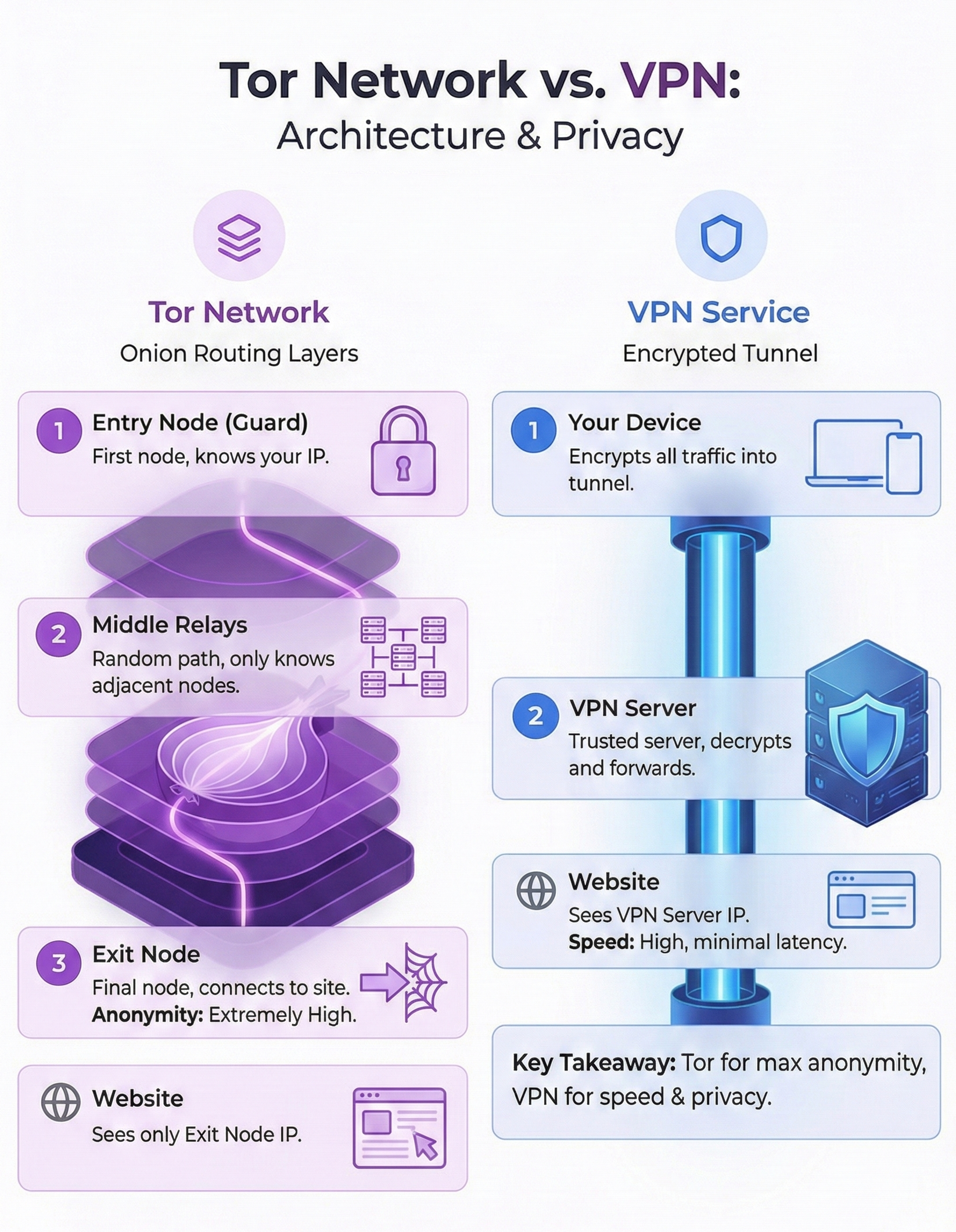
Tor: No single entity sees your full path. Trust is distributed across volunteer nodes.
VPN: Traffic is routed through a single VPN provider, making the provider’s infrastructure and privacy policy central to user trust. Reputable VPNs such as X-VPN use strict no-logs practices to protect user privacy.
Winner: VPN
VPNs route traffic through a single optimized server, resulting in relatively small speed loss. Most premium VPNs support HD and 4K streaming.
Tor routes traffic through multiple global nodes, introducing heavy latency. Even basic browsing can feel sluggish.
Winner: Tor (with caveats)
Tor is designed to provide stronger anonymity by routing traffic through multiple volunteer-operated nodes, making it well-suited for journalists, activists, and users in high-risk or hostile environments.
VPNs use a different privacy model. Reliable VPN providers operate under strict no-logs policies and are built to protect users from ISP tracking and local surveillance, while prioritizing speed, usability, and everyday privacy. Choosing a trustworthy VPN provider is essential.
Neither tool can guarantee complete anonymity against highly capable adversaries using advanced traffic correlation techniques.
Winner: VPN
Modern VPN apps are incredibly user-friendly—download, install, click connect. Most support all major platforms (Windows, Mac, iOS, Android, Linux) with native apps that handle everything automatically. You can even set them to connect on startup.
Tor requires downloading the Tor Browser (a modified version of Firefox) or manually configuring other applications to route through the Tor network. It’s not difficult, but it requires more technical knowledge and isn’t as seamless as VPN apps. Mobile support is also limited—Android has Tor Browser, but iOS support is minimal.
Winner: Tor
Tor is completely free and always will be. It’s maintained by a non-profit organization and thousands of volunteers who donate bandwidth by running relay nodes.
Reputable VPNs typically cost between $3-15 per month, with longer subscription periods offering better deals. While free VPNs exist, they are typically slow or have limited bandwidth.
The right choice depends on a single question:
Do you prioritize speed and convenience—or anonymity above all else?
VPNs are ideal for everyday privacy needs:
Bottom line:
👉 If you want fast, reliable, low-friction privacy, choose a VPN.
Tor is designed for situations where anonymity matters more than performance:
Bottom line:
👉 If anonymity is non-negotiable, choose Tor.
There is no universal “better” option—only the right tool for your goal.
Many privacy-conscious users keep both tools available and choose based on context.
Pro tip: Use VPN for daily activities (streaming, browsing, shopping) and Tor when you need maximum anonymity for sensitive activities.
Yes—though it’s rarely necessary.
Connect to your VPN first, then launch Tor Browser. This setup:
Route through Tor first, then connect to a VPN. This setup:
For most users, using both adds complexity without meaningful benefits.
Myth 1: “VPNs and Tor make me completely anonymous”
No tool eliminates all risk. Behavior, browser fingerprinting, and human error still matter.
Myth 2: “Tor is only for criminals”
Tor was created by the U.S. Navy for legitimate privacy purposes. It’s widely used by journalists, activists, researchers, and privacy-conscious individuals. While criminals do use Tor, they also use email, phones, and cash.
Myth 3: “Using Tor will get me in trouble”
Tor is legal in most countries. Your ISP can see you’re using Tor, but using privacy tools is not inherently suspicious. What matters is what you do with the tool, not the tool itself.
Myth 4: “VPNs protect against viruses and malware”
VPNs encrypt your connection but don’t scan for malware. You still need antivirus software and safe browsing habits. Some VPNs offer malware blocking as an extra feature, but it’s not their primary function.
X-VPN is more than just a VPN. It offers additional security features such as Safe Browsing, PC Protection, Identity Protection, and more. Visit our feature page to discover the full capabilities of our VPN app.
Think of a VPN as everyday armor—easy to use, practical, and effective against common threats.
Think of Tor as a secure bunker—slower and less convenient, but essential when anonymity truly matters.
For most people, a reputable VPN with a no-logs policy will cover the vast majority of privacy needs. In higher-risk scenarios, Tor’s decentralized design remains unmatched.
Whichever tool you choose, remember that privacy tools work best alongside good operational security. Use strong passwords, enable two-factor authentication, keep software updated, and stay mindful of what you share online.
One-click protection on all major devices, Fast speeds for streaming and daily browsing
Use a VPN. While Tor provides anonymity, it routes your traffic through random international nodes. This almost always triggers your bank’s fraud detection systems, locking you out of your account. A VPN connected to a server in your own country is secure and won’t flag suspicious activity.
No, never. The Tor Project specifically asks users not to use BitTorrent on their network. Torrenting clogs the network, slowing it down for activists and journalists who rely on it for safety. Furthermore, torrent clients often leak your real IP address even when using Tor, defeating the purpose. Use a VPN with P2P-optimized servers instead.
With a VPN: If the police have a warrant, they can force a VPN provider to hand over data. This is why using a provider with a proven “No-Logs” policy (audited by a third party) is critical. If they keep no logs, they have nothing to hand over.
With Tor: Tracking a specific user on Tor is incredibly difficult and expensive, usually requiring state-level resources (like the NSA). However, simply connecting to the Tor network is visible to your ISP, which can flag you for surveillance in some countries.
In most countries, no. Tor is legal in the US, UK, Canada, and most of Europe. However, it is banned or heavily restricted in countries with strict censorship, such as China, Russia, Iran, and Turkey. Always check your local laws before downloading the Tor Browser.
Yes, but it is manageable. While every active app drains battery, VPNs might require extra power to encrypt your data in real-time. Older protocols (like OpenVPN) can increase battery usage by 10–15%. To minimize this, use a VPN that supports the WireGuard protocol, which is significantly lighter, faster, and more energy-efficient.
For 99% of users, no. While connecting to a VPN before opening Tor does hide your Tor usage from your ISP, it is overkill for the average person. It effectively halves your internet speed and adds unnecessary complexity. You should only use this setup if you have a specific, high-threat model (e.g., you are a whistleblower in a hostile nation).
Article by
Nate Cipher is a privacy-focused tech writer at xvpn.io, specializing in online security, VPN technologies, and digital privacy education.

© LIGHTNINGLINK NETWORKS PTE. LTD. All Rights Reserved