


Free VPNs are still surprisingly popular. In fact, far more people use them than you might expect, and maybe you’re one of those wondering if it’s worth giving one a try. Yet there are also plenty of warnings that free VPNs aren’t safe, and free VPN safety has become a real concern for anyone who cares about privacy. Recently, Google‘s Trust & Safety team issued a public warning that fake “VPN” apps and extensions are being used to hide spyware and steal people’s passwords and banking details. In other words, these fears are no longer theoretical.
In this guide, we’ll look at why many people continue to use free VPNs, what risks are real, and what you need to check before using a free VPN. We’ll also show why X-VPN’s free version is one of the rare options that can meet these safety standards without treating your data as the price.
Table of Contents
Why Do VPN Providers Offer Free VPN Services?
The Positive Side: When “Free” Is Meant to Help Users
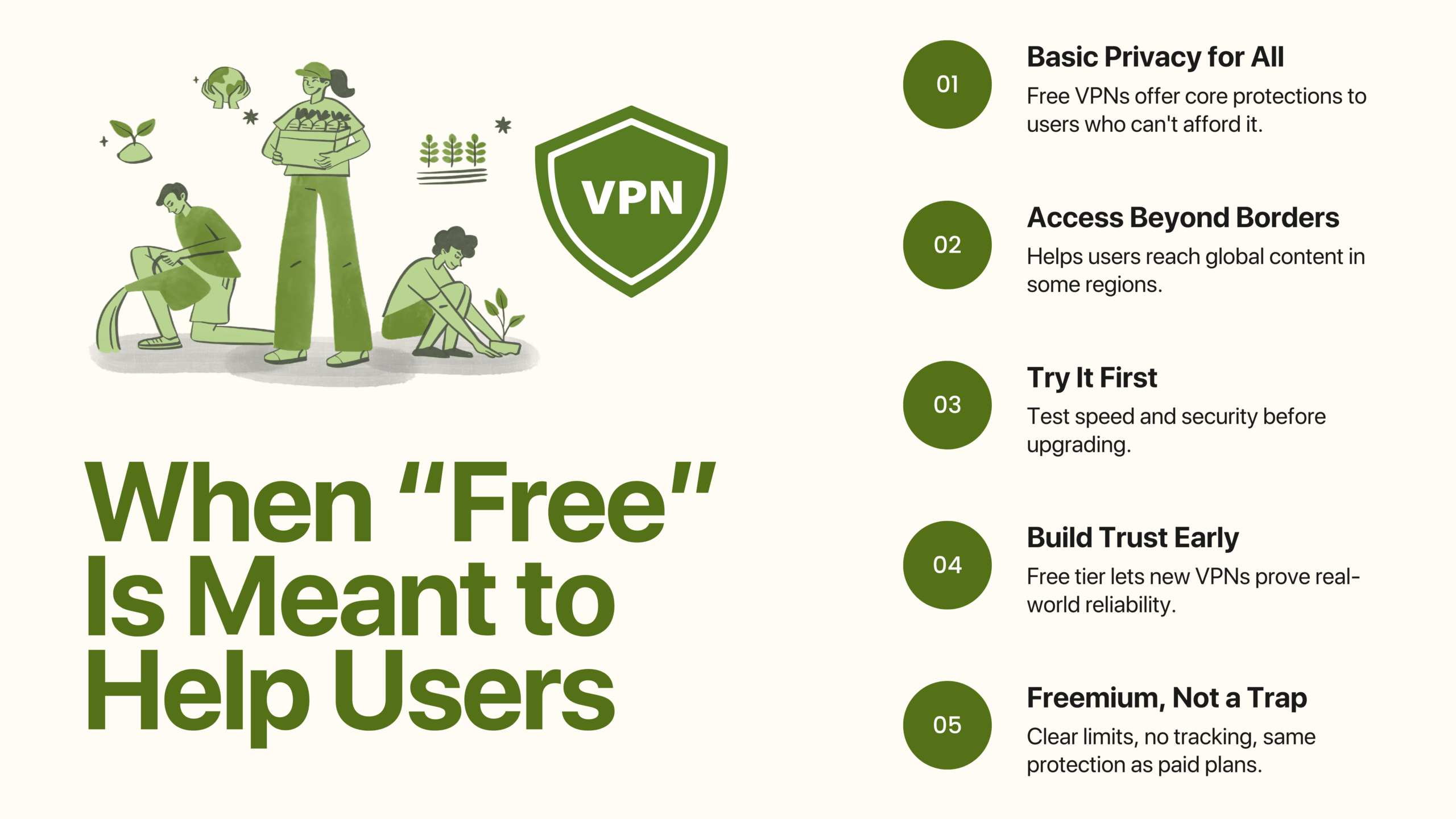
Not every free VPN is built on shady tricks. Some providers keep a free plan for user-first reasons, this is the camp X-VPN belongs to.
1. Making Baseline Security Available to Everyone
Online risks like account theft, data leaks, and unsafe public Wi-Fi affect ordinary people everywhere, not just businesses or “power users”. At the same time, a recurring VPN subscription is simply not realistic for many households and students.
That’s why some services offer a genuinely usable free tier: to give people basic encryption and IP protection even when they can’t pay. X-VPN’s free edition is designed with this in mind, it keeps core defences such as AES-256 encryption, a Kill Switch, and an audited no-logs policy, RAM-only server setup, so you don’t have to sacrifice privacy just because you’re on a tight budget.
2. Helping More People Cross Digital Borders
In some parts of the world, large portions of the internet are still filtered or blocked. For users in those regions, a free VPN isn’t a nice bonus, it can be their only practical way to reach essential information, tools, and services.
By maintaining a free tier, a VPN provider can lower the barrier for people who otherwise would never be able to use a secure connection. X-VPN’s free plan gives access to selected regions and stable connections so more people can study, work, and stay informed across borders, instead of being cut off by local restrictions or price.
3. Letting You Test the Service Before Committing
There is also a straightforward, transparent business reason: letting people try the product properly before they decide whether it’s worth paying for. A well-designed free plan shows you how the apps feel, how fast the network is, and whether the privacy model matches your expectations.
X-VPN uses its free version in exactly this way. You can stay on the free plan for as long as it meets your needs and only upgrade if you later decide you want more locations or advanced features. The goal is to earn your trust over time, not to push you into a paid subscription from day one.
4. To Help New VPN Startups Build a Real User Base
Every VPN product needs real users before it can prove itself. New VPN startups in particular have to show that their apps are stable, their speeds are acceptable, and their security model actually works in everyday use, not just in internal tests.
A free plan lowers the barrier for these early adopters. Instead of asking people to commit to a long subscription up front, startups can invite them to try the service in real life, gather feedback, and improve the product. As long as the free tier keeps the same fundamental protections as the paid one and is transparent about its limits, this is a legitimate way for a young VPN brand to grow.
5. They Use a Free Tier to Encourage Upgrades
Many VPN providers follow a classic freemium model. They offer a free plan with limited features, so that anyone can start using the service without paying.
Over time, a portion of these users decide to upgrade to the paid plan for more regions, better performance, or extra security tools. Others stay on the free tier but continue to rely on the VPN and recommend it to friends. In this way, the free version helps the provider build a long-term, loyal user base.
When this model is implemented transparently, with clear limits, no hidden tracking, and the same core security (encryption, audited no-logs policy) on both free and paid plans, it can be a fair way for a VPN business to grow, rather than a trap. X-VPN’s free version follows this approach: the feature set is limited compared to premium, but the underlying protection stays the same.
The Darker Side: Why Some Free VPNs Are Risky

Even so, free VPNs are not all created equal. There are still some other free VPNs on the market that can be harmful or risky to use, so it’s important to know what to watch out for.
1. They Collect and Sell Your Data
You might not realize just how valuable your personal data is. From showing you targeted ads to selling detailed records of what you do across different websites and apps, your online activity can be monetized in many ways. With some shady free VPNs, your data effectively becomes the “subscription fee.” These providers may sell your browsing history, location, or device details to third parties, quietly compromising your privacy without your awareness.
2. They Inject Malicious Code and Exploit Your Device
Some free VPN apps include hidden malicious code that runs silently in the background, so they can sell your IP or rent out your bandwidth to bad actors. Your device may be turned into part of a botnet, sending out automated requests, spamming, or even helping to carry out DDoS attacks.
From the outside, all this traffic appears to come from a regular user’s IP address — yours. You might not notice anything except a slower internet connection or degraded device performance.
3. They Bombard You with Ads
This one’s more obvious: many free VPNs earn money by showing ads while you’re connected. While you’re not paying with cash, you’re still paying with your attention.
Who Still Uses Free VPNs, and Why?
According to various industry reports, there are an estimated 1.6 to 1.8 billion VPN users worldwide. And as noted in DataFeature’s article VPN Statics, Trends & Facts, one in three VPN users globally rely on free VPN services, that is hundreds of millions of people.
So why do so many still choose free VPNs?
For many users, the answer is simple:
They only need a VPN for light, occasional use, like browsing while connected to public Wi-Fi or accessing a region-based site. Others might feel that monthly paid VPN subscriptions are too expensive, or worry about being locked into long-term contracts that last one or two years. And for some, especially students or users in lower-income regions, it’s simply a matter of affordability.
There is also a group of short-term or situational users who only need a VPN for a limited period, for example, during a trip abroad or a temporary stay in another country. Once that moment passes, they don’t see much value in paying for a long subscription, so a trustworthy free VPN can cover their immediate needs without commitment.
In addition, some paid VPNs have confusing subscription and renewal terms. Auto-renewals and small-print price changes have left some users paying when they thought they had already cancelled. After experiences like that, sticking with a clearly free, no-payment-required VPN is a reasonable choice, as long as it still meets basic safety standards.
Free VPN Safety Checklist: 9 Things to Look For
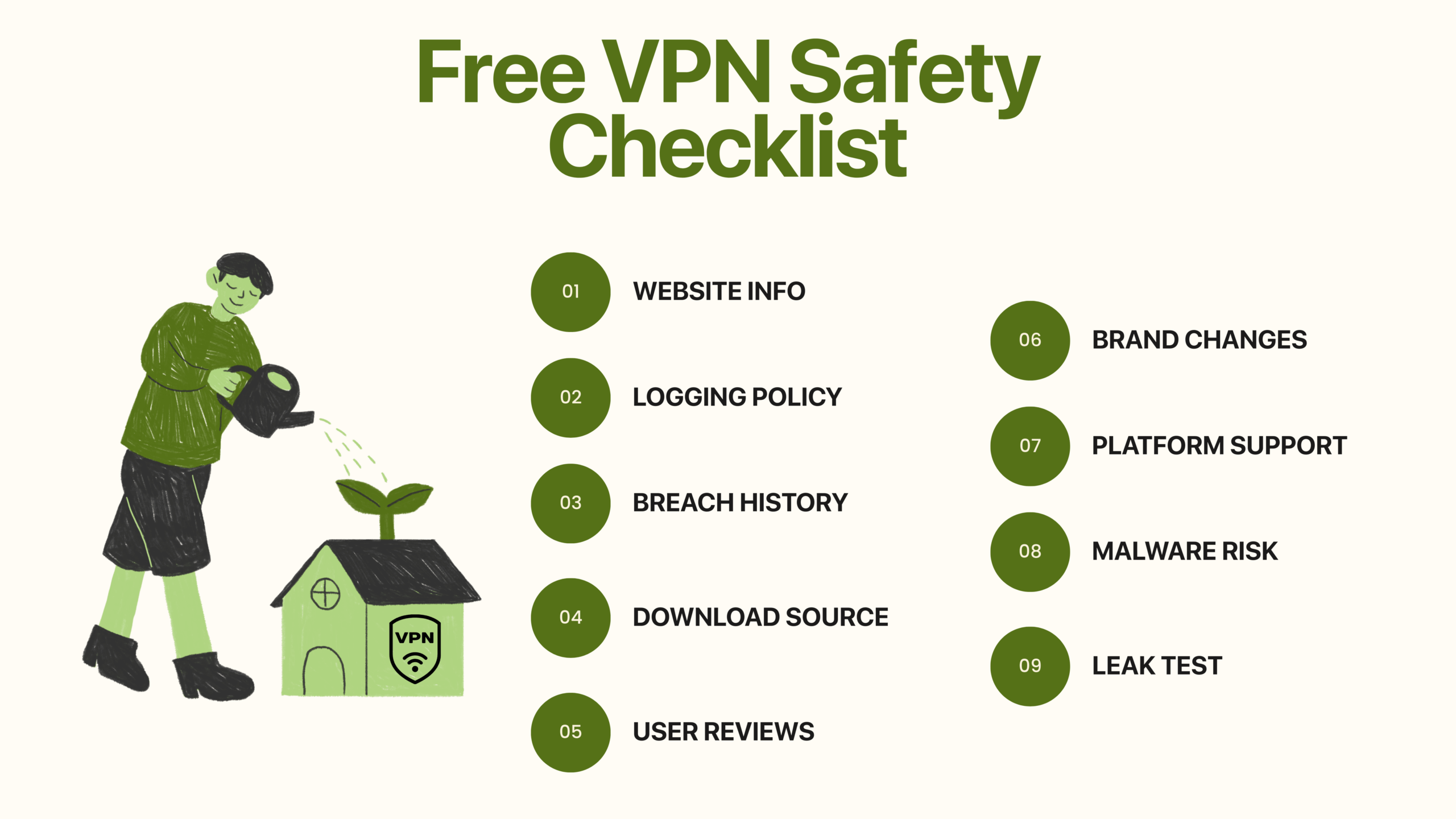
So, if you’re looking for a free VPN that’s actually safe to use, there are 9 key things you should check to protect your data and privacy:
1. Is There a Proper Website With Clear Information?
A safer VPN provider usually has a real website that explains what the product does, how it protects your data, and who runs it. If the website is just a single vague page with almost no information, no legal pages, and no way to reach the team, that’s a warning sign.
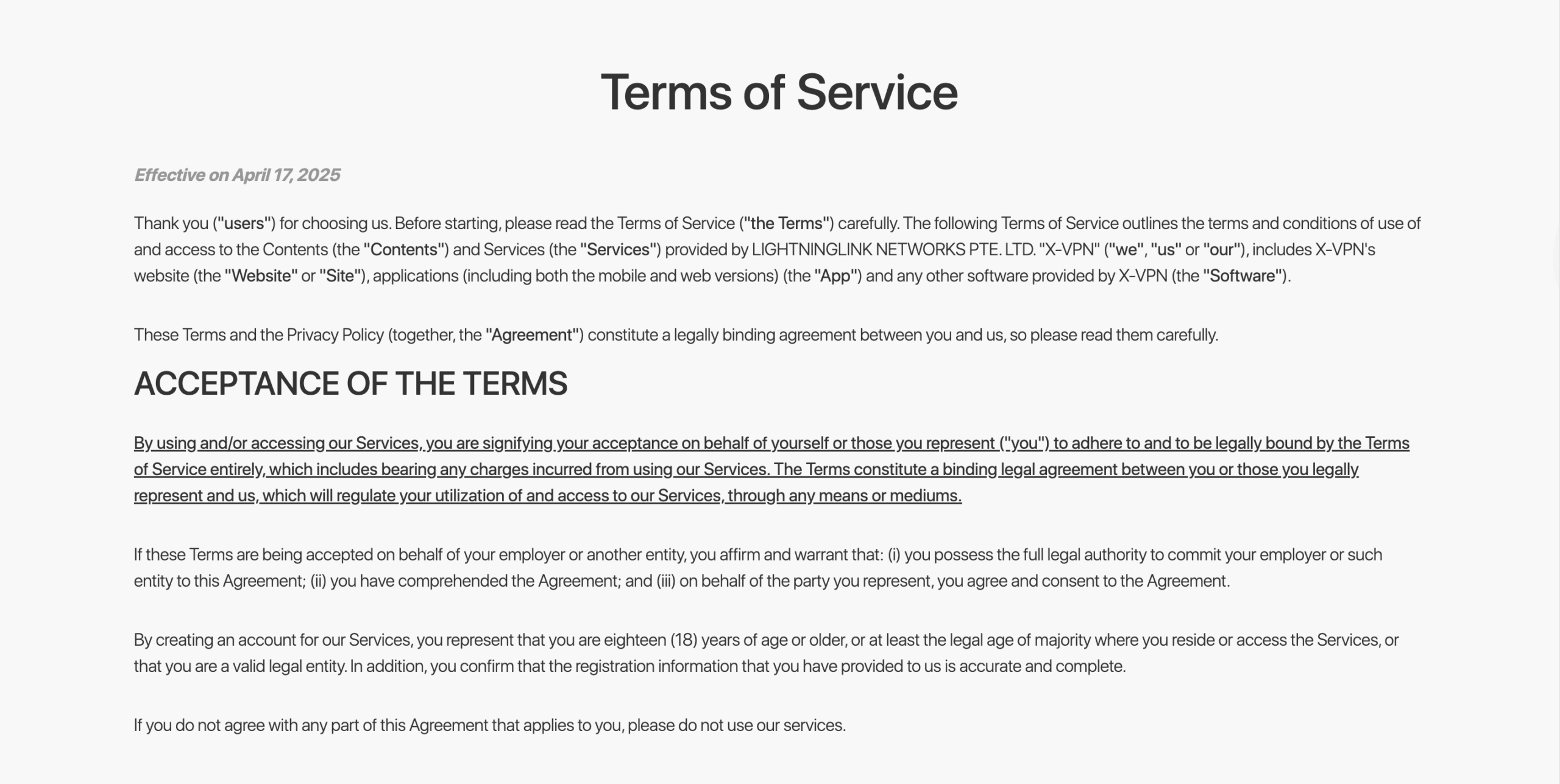
Look for a clear privacy policy, terms of service, and at least basic company details (name, country, and a support contact). While you’re there, pay attention to which country the company is based in. Many privacy-focused users prefer VPNs outside the 5/9/14 Eyes intelligence-sharing alliances, because providers in those jurisdictions may face broader data-access requests from governments.
2. Does it log or sell your data?
Check its no-logs claim and privacy policy.
As mentioned earlier, one of the biggest “prices” you may pay for a free VPN is your data. Be careful to check whether the free VPN you’re about to use actually has an audited no-logs policy. Read its official privacy policy, and look for a transparency report or an independent third-party audit that backs up what it claims.
This still doesn’t guarantee perfection, but it greatly reduces the risk that your activity will be logged, sold, or handed to others, which would be the exact opposite of why you use a VPN in the first place: to protect your online data.
3. Has the VPN Been Involved In Major Data Leaks or Scandals?
Before you trust any free VPN, search for its name together with terms like “data breach”, “logs”, “leak”, or “scandal”. If the provider has previously been caught logging users despite promising “no logs”, leaking databases, or being involved in serious privacy incidents, that’s a strong reason to avoid it. A trustworthy VPN should not have a history of exposing user data or misleading people about logging.
4. Where Are You Downloading The App From?
Always download a free VPN from trusted channels, such as the official website or official app stores (Google Play, Apple’s App Store, etc.). Avoid random APK download sites, pop-up ads, or file-sharing links. Official stores are not perfect, but they do basic checks and remove apps that are clearly malicious far more often than unregulated download sites.
5. What Do Real Users Say In the Reviews?
Star ratings alone don’t tell the full story. Scroll through recent reviews and pay special attention to 1-3 star feedback. Repeated complaints about unexpected charges, crashes, or privacy concerns are worth taking seriously. Also be cautious if you see lots of almost identical 5-star reveiws with very short, generic comments, which can indicate review manipulation. Reviews are not perfect, but they’re a useful signal when combined with the other checks on this list.
6. Has the App Changed Its Name or Branding Suspiciously Often?
In app stores, check the app’s history and the developer page. If the same app or developer has changed names, icons, and descriptions multiple times, or has a trail of very similar apps that keep being rebranded, it might be trying to bury bad reviews or damaged reputation. Frequent “re-skinning” and name changes are common tactics for low-quality or deceptive VPN apps, so treat them as a red flag.
7. Is It Only Available on One Obscure Platform?
It’s perfectly fine for a VPN to start on one platform first, but be cautious if an app exsits only on a single, obscure platform and has no matching listing elsewhere under the same brand or developer. Reputable VPNs usually aim to support multiple platforms over time (for example, both mobile and desktop), and they use a consistent brand name and publisher across stores. A “VPN” that appears once on an isolated store with no visible ecosystem deserves extra scrutiny.
8. Is It Bundled with Malware?
Check whether a free VPN is bundled with malware or hijacks your browser traffic.
It’s not uncommon for shady free VPNs to come with malicious components. A malware-infected app or browser extension can steal your personal data, or even give attackers remote control over your device. Always scan the installer or app with a reputable security too. For example, Microsoft Defender on Windows or an online multi-engine scanner like VirusTotal, to see whether it’s flagged as malicious.
This can also happen when you use an unknown or fake “free VPN”, especially if it’s just a browser extension. For example, PCRisk has analysed the SearchVPN extension, which is promoted as a VPN add-on but is actually classified as a browser hijacker. Once installed, it changes your browser settings and promotes a fake search engine like kwsrc4you.com by setting it as your default search engine, homepage, and new-tab page. Whenever you type a query in the address bar or open a new tab, you are first redirected through this site before you see real search results.
Security reports also note that the SearchVPN hijacker can track your browsing data, such as the URLs and pages you visit, your search queries, and other potentially sensitive information, and then monetise it by selling it to third parties.
9. Does It Pass Basic VPN Leak Tests (IP and DNS)?
After installing a free VPN, connect to it and run a quick IP test and DNS leak test using any of the many websites that offer this (like X-VPN). If you mainly use the VPN in a browser, it’s also worth checking for a WebRTC leak test, many leak-test sites include this by default. Then disconnect and run the same tests again. If your IP address or DNS servers look exactly the same with and without the VPN, or the test still shows your real country and ISP while you’re “connected” somewhere else, the VPN is not doing its job properly.
Are There Any Safe Free VPNs?
So, after reading about so many shady and untrustworthy free VPNs, you might wonder: are there still any truly safe free VPNs worth trying?
Yes. One of the few free VPNs that can be checked against all the criteria above is X-VPN’s free version, which lets you test these standards yourself while still enjoying a smooth, no-cost VPN experience.
Why X-VPN Is a Rare Exception
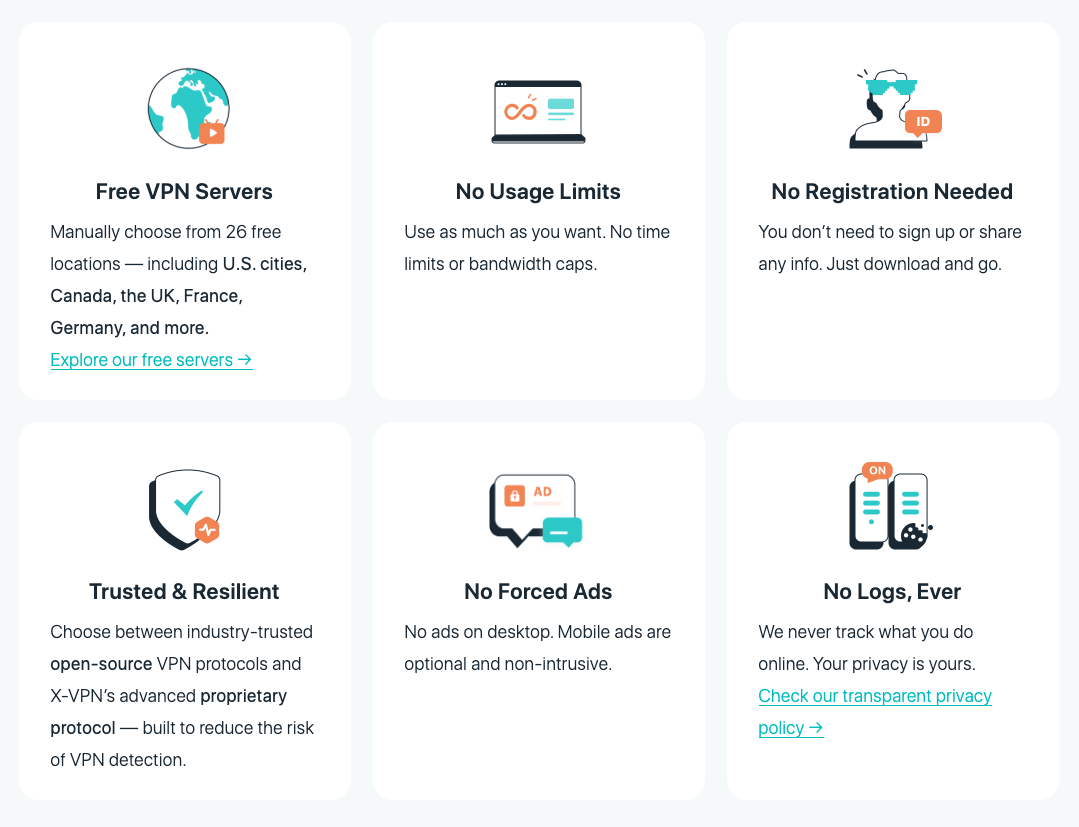
AES-256 Encryption & Kill Switch
X-VPN use bank-grade AES-256 encryption, so free users gets the same level of encryption as premium users. With its Kill Switch feature now available on iOS, Android, Windows, and macOS, you don’t have to worry about your data being exposed if the VPN connection drops, the app automatically blocks all internet traffic until the securre tunnel is restored, helping prevent your real IP address and unecnrypted data from leaking.
Full Transparency
X-VPN maintains a fully open transparency report covering data from 2017-2025, along with a detailed trust center and privacy policy, so you can clearly see how your data is handled. X-VPN is built around an audited no-logs approach and uses RAM-only servers for both free and premium users, which means sensitive activity data is not written to disk and there is nothing to hand over or sell to third parties.
Unlimited Data
Many free VPNs heavily limit data on their free plans, but not X-VPN. The free version offers unlimited data and access to 1,000 servers, so you don’t have to constantly watch how much bandwidth you have left. Whether you’re streaming, gaming, or just browsing, you decide how long you want to stay connected.
Multi Platforms
X-VPN’s free version is available on iOS, Android, Mac, Windows, and Chrome, and you can use it without registration. Just install the app or extension, and you’re ready to go with a secure VPN on whichever device you’re using.
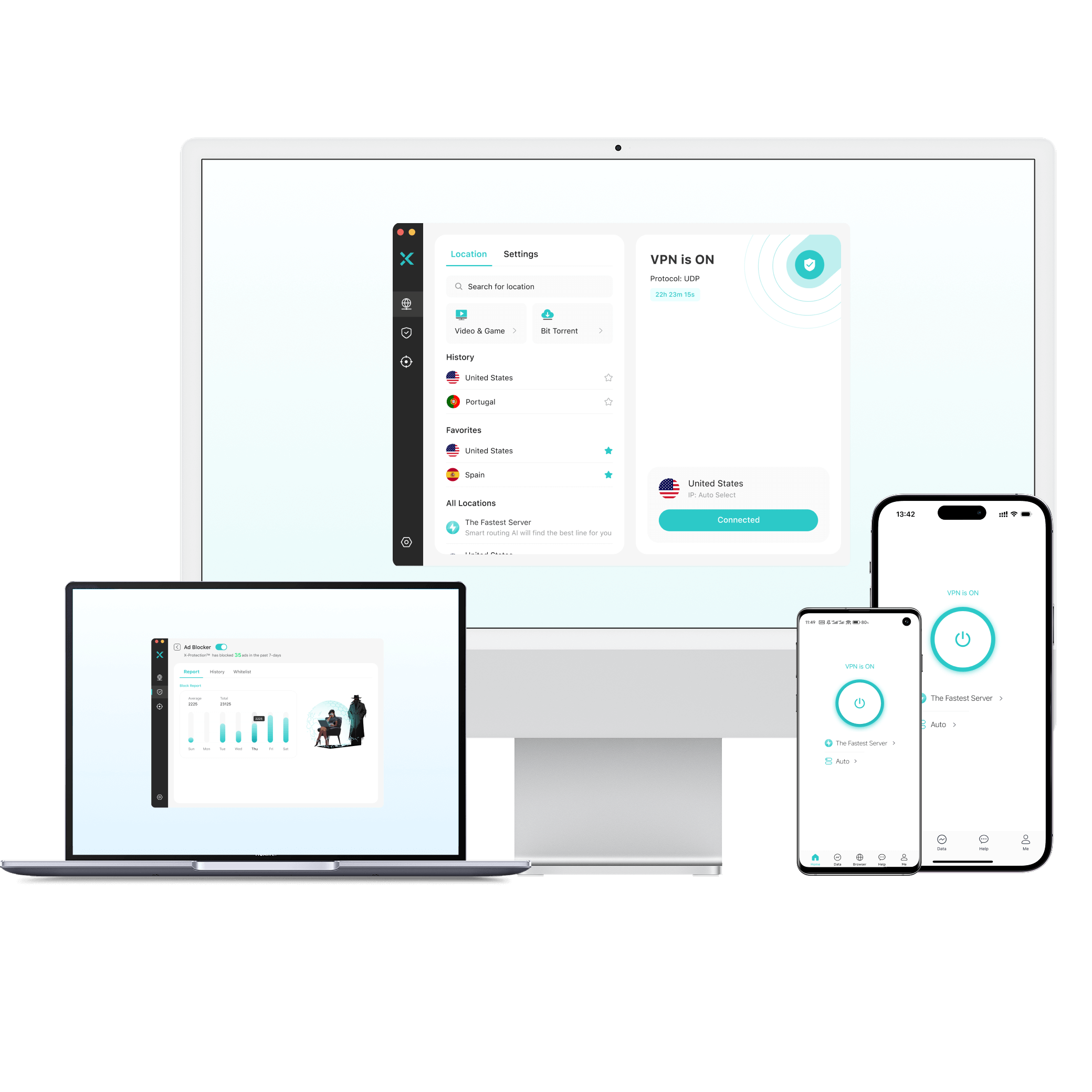
Download X-VPN Free
Stay Safe Online Now
AES-256 Encryption
RAM-Only No-Logs Servers
Kill Swtich
1,000+ Servers
…
Conclusion
Free VPNs may look convenient, but many of them “charge” you in other ways, through data collection, malware, or unstable connections. If you really want to use a free VPN, always run through a basic safety checklist: strong encryption, an audited no-logs policy, clean security scans, acceptable speed, reasonable server coverage, and a trustworthy company behind it.
X-VPN’s free version is one of the rare options that meet these standards, combining AES-256 encryption, a Kill Switch, RAM-only no-logs servers, transparency reports, unlimited data, and multi-platform support to give you a free VPN that’s actually built with safety in mind.
FAQ
Is it risky to use a free VPN?
Yes. Using a free VPN can be risky. Many free services make money by logging your activity or building malware, which can expose your data instead of protecting it. If you need a safer free option, look for providers like X-VPN, which offer AES-256 encryption, an audited no-logs approach and a documented transparency report instead of trading on your data.
Are there any free VPNs that are safe?
Yes. A small number of free VPNs are relatively safe, especially those that also run a paid service and are transparent about logging and security. Independent reviews highlight that “freemium” providers with clear policies and modern encryption are much safer than random free apps in the store. X-VPN’s free version fits this model: it uses AES-256, offers unlimited data on 1,000+ servers, requires no account, and follows an audited no-logs strategy backed by public transparency reports.
Can a free VPN protect my privacy?
Yes. A trustworthy free VPN can improve your privacy, but many actually weaken it. Research on free VPN apps has found widespread data leaks and tracking, so encryption alone is not enough if the provider logs or sells what you do. To really protect your privacy with a free VPN, choose one like X-VPN.
Do free VPNs sell your info?
Many free VPNs do sell or share user information, because data monetisation is their main business model. One analysis warns that a majority of free VPNs either log user activity or pass data to third parties, which directly undermines privacy. In contrast, X-VPN states that it runs all servers in RAM-only, applies the same audited no-logs policy to free and paid users, so there is no long-term activity history to sell.