



You can install a VPN on a phone in a minute. Just tap a button and forget about it while it encrypts your internet connection. That simplicity hides decades of critical network developments.
Virtual private networks didn’t begin as consumer privacy tools. The technology grew from the needs of organizations that wanted offices and employees to connect securely across long distances without building an entire private communications network. The internet offered a cheaper path, but they needed a way to make part of that public infrastructure behave more like a private network.
The basic VPN idea grew from a need to safely use a network you don’t control to access or exchange information that should remain private.
The same approach used to connect employees with corporate networks became necessary to protect ordinary internet users, hiding IP addresses, accessing services while traveling, and getting around censorship.
Table of Contents
Before VPNs: Connecting Computers Securely
Private computer networks existed long before today’s VPN apps. Large companies, universities, and government organizations could connect computers and offices using dedicated or leased communication lines. The advantage was control. Traffic could stay on infrastructure intended for the organization instead of traveling across a public network.
The disadvantage was cost and complexity. As computer networks grew, organizations wanted employees and branch offices to connect from farther away. Dial-up networking provided one solution. An employee could use a modem and telephone line to dial directly into a company’s remote access server.
That worked, but maintaining large pools of modems and paying long-distance charges wasn’t particularly elegant or scalable. Meanwhile, the internet was becoming a remarkably effective worldwide network. Instead of establishing a dedicated connection all the way to the office, why not connect to a local internet service provider and use the internet for most of the journey?
The obvious problem was that the internet was public infrastructure. A company couldn’t simply expose its internal network and confidential data to everyone along the route. It needed some way to create a protected connection across that shared network. The internet could provide the road, while a secure tunnel could provide privacy.
The Birth Of The Modern VPN
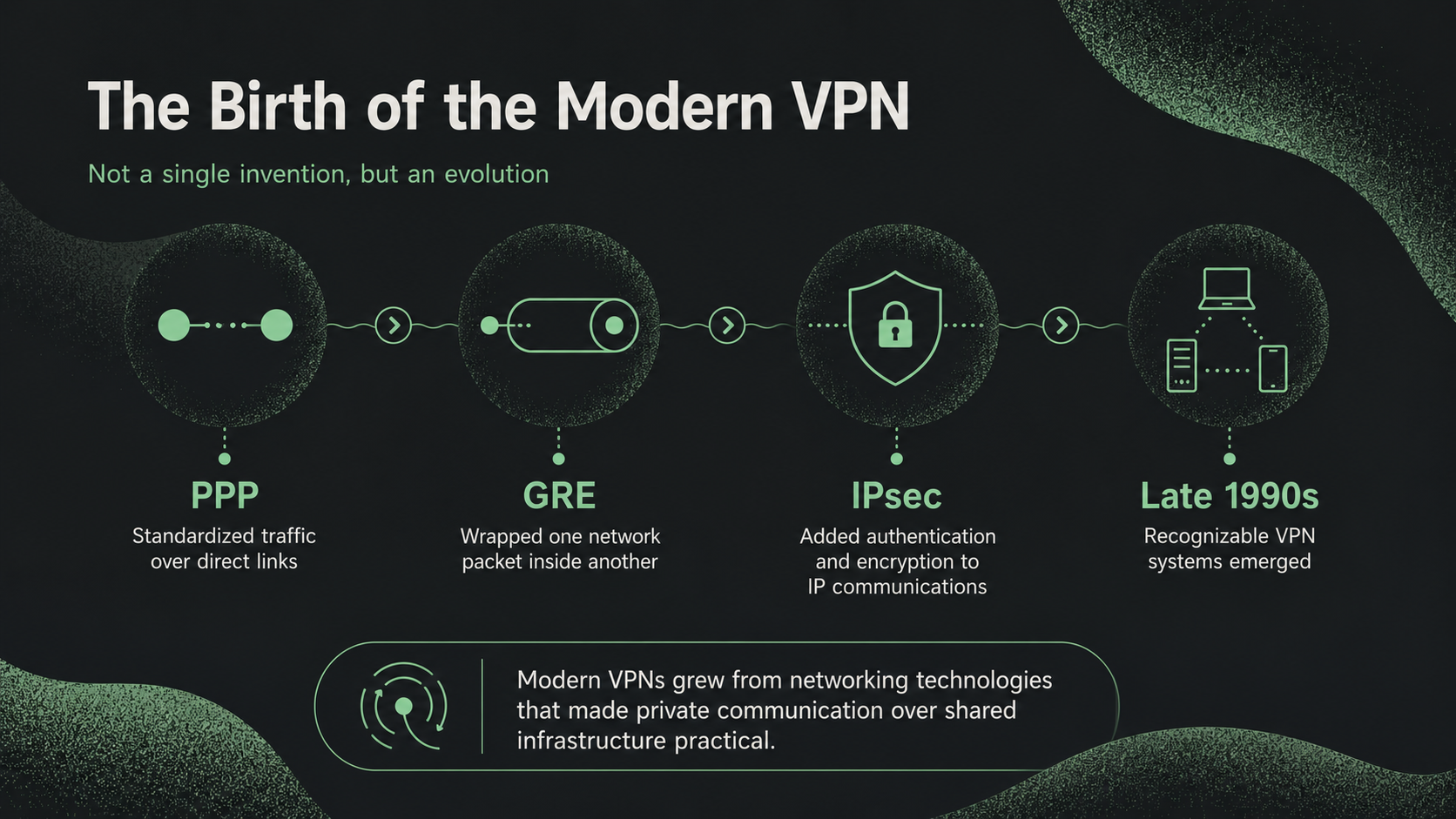
It’s tempting to assign VPN technology a birthday, but there isn’t a single moment when someone switched on the world’s first VPN.
Several technologies that VPNs depend on were already developing by the early and mid-1990s. Point-to-Point Protocol (PPP) standardized a way of carrying network traffic across direct links. Generic Routing Encapsulation (GRE) provided a method for wrapping one type of network packet inside another. Work on Internet Protocol Security, better known as IPsec, brought authentication and encryption directly to Internet Protocol communications.
These technologies contributed pieces of what we’d now recognize as VPN functionality. The term itself also covered more than one approach. A VPN could connect an individual computer to a private network, join two distant office networks, or let a telecommunications provider create logically separated private networks for customers over shared infrastructure.
VPNs are better understood as an evolution of networking technologies that made private communication over shared infrastructure increasingly practical. By the late 1990s, that evolution had produced recognizable VPN systems, and the idea was becoming important enough that the Internet Engineering Task Force (IETF) was working on frameworks specifically describing IP-based virtual private networks.
PPTP and the Rise of Remote Access
In the mid-1990s, Microsoft and several networking companies developed Point-to-Point Tunneling Protocol (PPTP). Microsoft incorporated PPTP support into Windows NT 4.0, describing it in 1996 as a technology that extended its Remote Access Server to enable secure private networks across the internet.
PPTP essentially allowed PPP traffic to be carried, or tunneled, across an Internet Protocol network. Instead of dialing directly into an office over a long-distance telephone connection, a remote worker could connect to the internet and establish a tunnel back to the corporate network. That’s remarkably close to the experience of connecting to a VPN today, even though the underlying technology has changed considerably.
PPTP helped make VPN-style remote access practical on mainstream computers. That is probably why Microsoft is sometimes credited with inventing the VPN. It’s more accurate to say PPTP was an important milestone in the development and popularization of VPN technology.
Its security hasn’t aged nearly as well as the basic idea. Weaknesses in PPTP were being addressed by Microsoft as early as 1998, and the protocol is now considered obsolete for secure VPN use.
But the concept was powerful. Connect to the internet, create a tunnel through it, and emerge securely inside another network. You can still see the same basic architecture in an explanation of how a modern VPN tunnel works.
VPNs Become a Business Essential
Early VPN adoption was primarily about private access rather than hiding what employees did online. Companies needed remote access to internal servers, files, databases, email systems, and other resources that weren’t publicly available.
VPNs offered a cheaper, more flexible alternative to relying entirely on dedicated network lines or direct long-distance dial-up connections. Traveling employees could connect from hotels and homes, while site-to-site VPNs could securely link entire branch offices to headquarters over the internet.
For businesses, the VPN became a bridge across infrastructure they didn’t own.
That purpose remains important today. Corporate VPNs are still widely used for remote access, although they’re now joined by cloud services, zero-trust security models, and other approaches that provide access to specific company resources.
From Corporate Tool to Consumer Privacy Product
In the 2000s, broadband connections replaced dial-up for many users, Wi-Fi became commonplace, laptops went everywhere, and eventually smartphones put a permanent internet connection in our pockets. People were spending more of their lives online, often across networks they didn’t control.
The same basic technology that let an employee establish an encrypted connection to work could be adapted to send ordinary internet traffic through a remote VPN server. That changed the purpose of the tunnel.
Instead of using a VPN primarily to reach a private company network, consumers could use one to protect their traffic as it crossed a local network and internet service provider. Websites would see the VPN server’s public IP address instead of the user’s home IP address.
The VPN had shifted from access to a private network to a privacy layer for the public internet.
Public Wi-Fi made that proposition particularly easy to understand. Coffee shops, airports, hotels, and other shared networks were convenient but difficult for users to trust. Encrypting traffic with a VPN on public Wi-Fi added protection when using networks controlled by someone else.
Growing concern about internet tracking and surveillance gave VPNs another role. A VPN couldn’t make someone anonymous or stop every form of tracking, but it could reduce what an internet service provider or local network could observe and hide a user’s public IP address from websites and online services. The audience for VPNs was becoming much larger than corporate IT departments.
How VPN Protocols Evolved

The VPN concept has remained surprisingly consistent, but the protocols used to create tunnels have changed considerably.
PPTP was attractive partly because it was relatively simple and widely supported. As its weaknesses became clear, stronger alternatives became more important.
IPsec provided a collection of technologies for securing Internet Protocol traffic and became widely used for corporate VPNs. Layer 2 Tunneling Protocol (L2TP) was often paired with IPsec, combining tunneling with encryption and authentication.
OpenVPN, publicly released in 2002, took another approach. As open-source software, it became a popular and flexible option that could work across operating systems and networks. Its ability to operate using either Transmission Control Protocol (TCP) or User Datagram Protocol (UDP) also helped it adapt to different network conditions.
WireGuard was created by Jason Donenfeld in the 2010s with an emphasis on simplicity, modern cryptography, speed, and a much smaller codebase. It was incorporated into the Linux kernel in 2020 and has since become widely supported by commercial VPN services.
The WireGuard protocol reflects how much VPN priorities have changed. Security is still fundamental, but speed, battery efficiency, quick connections, and smooth performance on phones are now extremely important.
Modern VPN services may support several VPN protocols because no single approach is ideal in every situation. Some prioritize compatibility, some speed, and others resistance to blocking. The tunnel stayed, while the machinery inside it kept improving.
That evolution is still happening. Proprietary protocols such as Everest combine encryption with obfuscation designed to make VPN traffic harder for restrictive networks to identify and block.
Why VPN Use Exploded
Consumer VPN adoption wasn’t driven by one problem. Several trends made the technology useful to people who had no interest in connecting to a corporate file server.
Privacy was one. As advertising networks, internet service providers, websites, and apps became increasingly sophisticated at collecting data, more people began looking for ways to limit how easily their activity could be associated with their internet connection.
Streaming added another reason. Online video services often offer different catalogs in different countries because licensing agreements vary by region. Since websites can estimate a visitor’s location from an IP address, connecting through a VPN server in another region can change the location the service sees. Travelers also began using VPNs to access familiar websites and services from abroad.
Censorship created a more serious use case. Governments and networks can block websites and online services, and VPNs became one of several technologies people use to reach information that would otherwise be inaccessible. This has also created an ongoing technological contest as some networks attempt to detect and block VPN traffic while VPN developers find ways around those restrictions.
One technology had accumulated several very different jobs. A VPN handles corporate access, privacy, public Wi-Fi security, travel, streaming, and censorship circumvention.
Smartphones accelerated the trend further. A VPN was no longer something configured by an IT administrator on a work laptop. Anyone could download an app, choose a server, and connect. That simplicity transformed VPNs into a mainstream internet service.
What Modern VPNs Do That Early VPNs Didn’t
Put an early corporate VPN beside a modern consumer VPN app and the family resemblance is still there. Both create logical private connections across shared infrastructure, but their jobs are very different.
An early remote-access VPN primarily needed to get an authenticated employee safely into a company network. A modern consumer VPN may route nearly everything a phone, tablet, or computer sends to the internet through a remote server.
Modern services also add features such as kill switches that block traffic if the tunnel fails, split tunneling that lets selected apps bypass the VPN, and worldwide server networks that let users choose where their traffic reaches the public internet.
They also have to cope with streaming platforms, restrictive networks, and phones constantly moving between Wi-Fi and cellular connections. Today’s VPN is expected to disappear into the background while protecting a much more complicated digital life. That’s a very different challenge from letting a Windows NT laptop connect securely to the office.
Where VPN Technology is Heading
VPNs continue to evolve because the internet around them keeps changing. Newer protocols emphasize speed and efficiency, particularly on phones, tablets, and laptops that switch networks frequently. Obfuscation has become increasingly important on restrictive networks that attempt to identify and block VPN traffic.
At the same time, VPNs are becoming part of larger privacy and security packages. Threat blocking, malicious-site protection, identity monitoring, and other security features increasingly sit alongside the encrypted tunnel.
That doesn’t mean the VPN itself is becoming obsolete. Its fundamental job remains useful, creating a protected path across a network you don’t completely trust.
The challenge now is making that protection faster, less visible, and easier to maintain across an increasingly complicated internet.
Future VPN protocols will undoubtedly look different from PPTP, just as WireGuard looks very different from the technologies of the 1990s. But the problem they’re solving would be immediately recognizable to the engineers working on remote access three decades ago.
Final Thoughts
Microsoft and its partners made an important contribution with PPTP, adding to the private networking, encapsulation, encryption, and secure remote access that were developing along several paths. What changed most dramatically was who needed this technology.
VPNs began largely as a solution for organizations trying to connect people and networks securely across public infrastructure. As the internet became central to everyday life, that same concept became valuable to everyone.
Today, VPNs protect connections that their original designers could barely have imagined, from smartphones hopping between cellular networks and coffee-shop Wi-Fi to TVs streaming video from servers on another continent.
The technology evolved and its audience exploded. Its uses multiplied, but the central idea survived intact. Sometimes the safest way across a public network is to build a private tunnel through it.
FAQ
When was the VPN invented?
There isn’t a universally accepted date because VPNs evolved from several earlier networking and security technologies. The mid-1990s were a crucial period, however. Microsoft and several networking companies developed PPTP, and Microsoft included the technology with Windows NT 4.0 in 1996. IPsec and other tunneling technologies were also developing during the 1990s.
Who invented the VPN?
No single person can accurately be called the inventor of the VPN. Microsoft engineer Gurdeep Singh-Pall is often credited with an important role because he co-authored PPTP, one of the earliest widely used VPN protocols. However, PPTP was developed by a consortium that included Microsoft, Ascend Communications, 3Com, ECI Telematics, and U.S. Robotics. VPN technology itself also grew from earlier work on tunneling, encryption, authentication, and private networking.
What were VPNs originally used for?
Early VPNs were primarily developed to let organizations connect remote employees, offices, and networks securely across shared infrastructure such as the internet. This could reduce reliance on dedicated leased lines and direct long-distance dial-up connections while still providing access to private corporate resources.
What was the first VPN protocol?
There’s no completely clean answer because technologies that provided VPN-like functions predate the term’s modern usage. PPTP, introduced in the 1990s, was one of the earliest widely deployed remote-access VPN protocols and helped popularize the concept on personal computers. IPsec was also being standardized during the same period.
When did people start using VPNs at home?
Consumer VPN services became increasingly common during the 2000s and 2010s as broadband, public Wi-Fi, smartphones, streaming, and concern about online privacy grew. App stores and easy-to-use VPN software eventually removed much of the technical knowledge once required to establish a VPN connection.
Are modern VPNs fundamentally different from early VPNs?
The underlying idea is remarkably similar. Both create a private logical connection across shared network infrastructure. What has changed most is the technology used to secure and maintain that connection, along with its purpose. Early VPNs focused heavily on connecting employees to corporate networks, while modern consumer VPNs commonly protect general internet traffic, hide public IP addresses, change apparent locations, and help users access the open internet from restrictive networks.